This blog post by Mona Jamil, our Head of Civic Engagement and Lucy May Maxwell, our Collections Researcher, was originally published on the Museum Ethnographers Group blog.
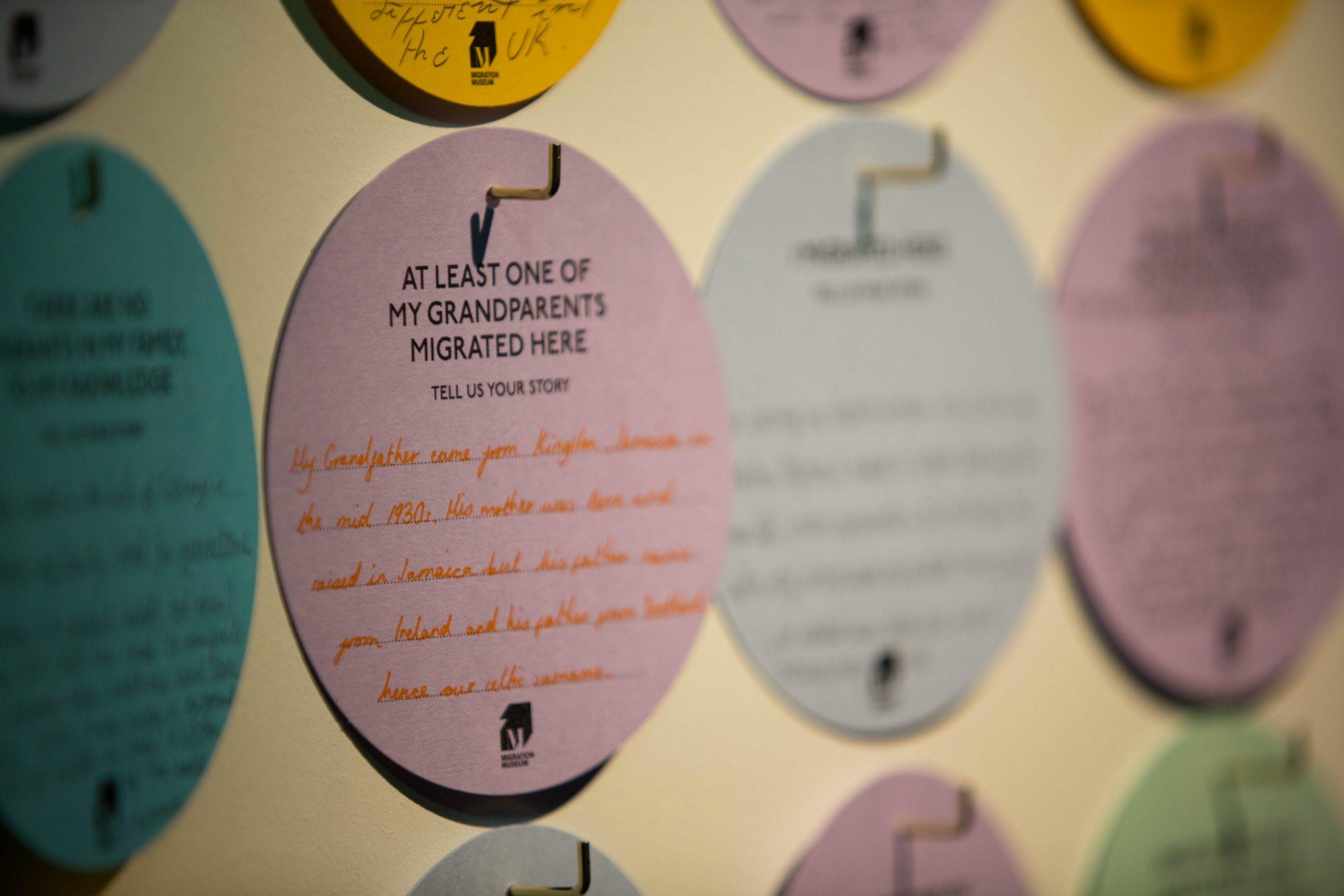
Some of the many thousands of migration story discs contributed by visitors to the museum. Photo credit: Migration Museum.
The Migration Museum is a young, emerging museum, founded around a kitchen table by people with a belief that the Migration Museum was the UK’s missing museum. Migration is the thread that connects us all – the movement of people to and from these shores across the centuries has shaped who we are and where we’re going. And how else to explain our culture – from food, to music, to architecture – without understanding the cross-currents of people moving in and out of the country?
The ‘kitchen table’ museum began in 2013. The small, committed team that became the museum’s first employees has been prodigious in their outputs ever since. There’s been a high rate of successful thematic story-led temporary exhibitions, the award-winning learning programme, and the development of a national Migration Network, which brings together people working on migration themes across the museums, heritage and academic sectors.
The team has connected with people through a genuine, deeply embedded process, including the development of our community engagement toolkit. Along the way, we’ve collected over 10,000 personal migration stories shared with us by visitors to our museum. And in 2025, we built a digital dispersed Migration Collection prototype that pulls together migration-related objects from established museums and archives. All of which has been achieved without the museum establishing a permanent collection.
Now, we are developing the museum’s first set of core exhibitions for our permanent home – opening in the City of London in 2028. As a new museum project that has migrated from site to site over several years, the phrase ‘permanent galleries’ seems too static when describing our exhibition content. How do we bring the magic of the temporary, the responsive, the participative into displays that need to withstand the high visitor traffic we’re hoping for over five, seven, ten years?
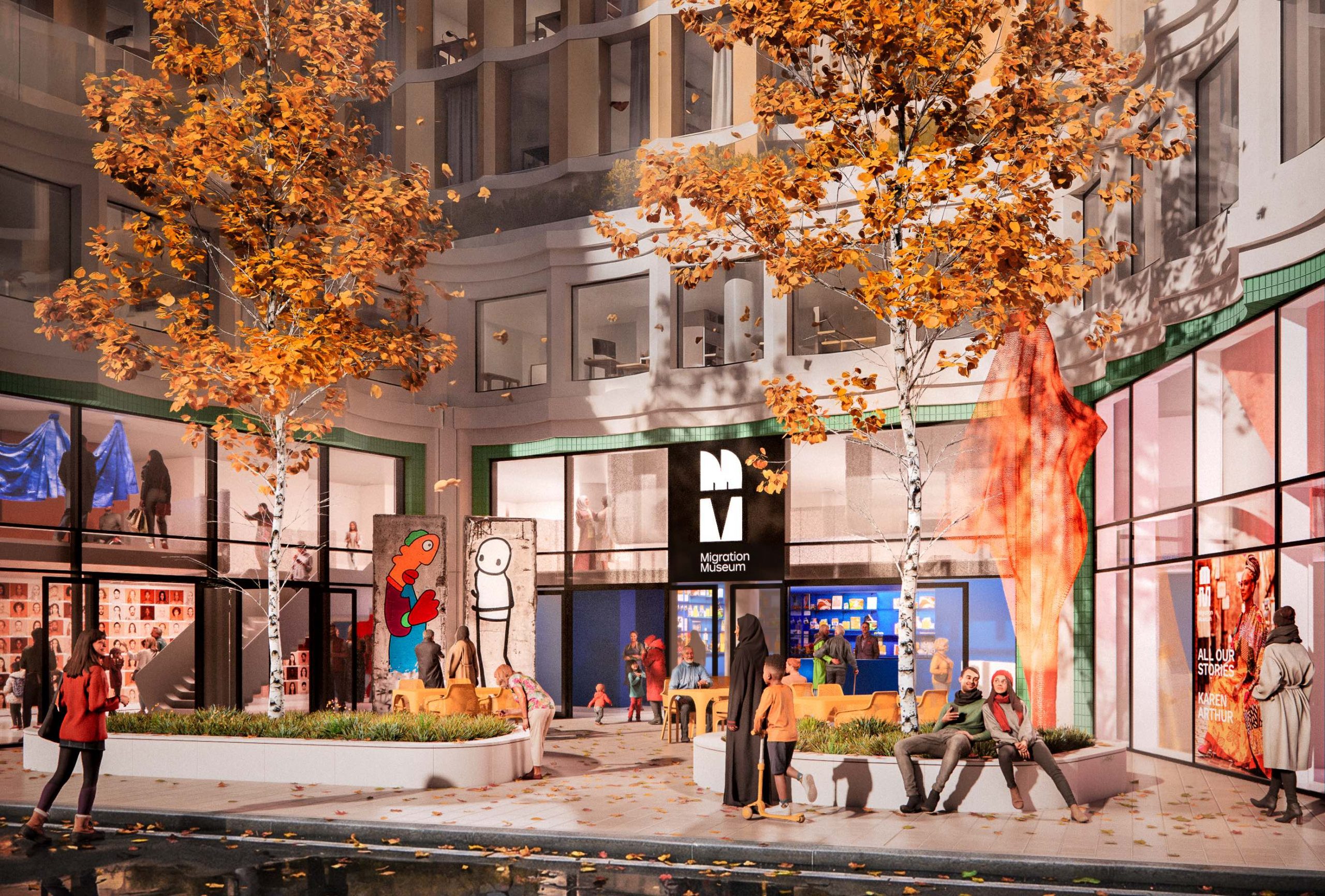
Visualisation of the entrance to the Migration Museum’s new permanent home. Visualisation: Unknown Works
Becoming a collecting organisation
In November 2025, we ran a survey, asking the museum sector and our Migration Network for advice on how the Migration Museum could responsibly become a collecting organisation. The survey allowed us to identify gaps in migration-related collections in the UK, whilst also identifying institutions we could potentially borrow objects from in the future.
Staff responded from different types of institutions including national, civic, and independent museums. The responses conveyed a mix of caution as well as excitement for our collecting plans. While museums are proud of the way they’ve told migration stories in temporary exhibitions, they advised us against collecting too rapidly. Over time, contextual information of objects can be lost, and managing collections can become the overwhelming responsibility of a small team, rather than researching and using those collections.
Here’s just a few of the valuable pieces of advice we received:
“Be cautious in how you acquire but bold in how you use your acquisitions. Consider ownership carefully, and the link between ownership and power. I don’t think a museum HAS to have a permanent collection.”
“Think about the idea of a dispersed national collection of migration. We should absolutely have a dedicated collection but it shouldn’t replicate what might exist. Think about how loans and transfers from other collections might create a richer and more dynamic whole.”
“Consider how you will use the items you collect and their stories. Imagine someone managing the collection in 100 years, will they have what they need to tell a variety of stories? Be prepared to dispose of things if you realise later on that collecting them wasn’t the best choice.”
The message was clear: collect a small number of key objects that reflect and enhance the mission and vision of the museum. Become the kind of museum that thrives on object loans from other organisations. Continue to show the museum sector the playful, informal, interactive, thoughtful displays that can be created with or without objects.
From our non-museums-based network members, we were offered a kaleidoscope of ways of engaging visitors such as campaigning, podcasting, leading walking tours, appearing at music festivals, and developing performance pieces.
Resolving the big questions
Can we both become a collecting organisation and remain playful? What does it mean for an organisation to grow up?
To help us resolve these big questions, the Migration Museum team hosted a workshop with consultants Claire Fry and Emma Chaplin in February 2026. We spent the day discussing the pros and cons of establishing a collection, what the Museum Accreditation process involved, and how it would support our work in the long term.
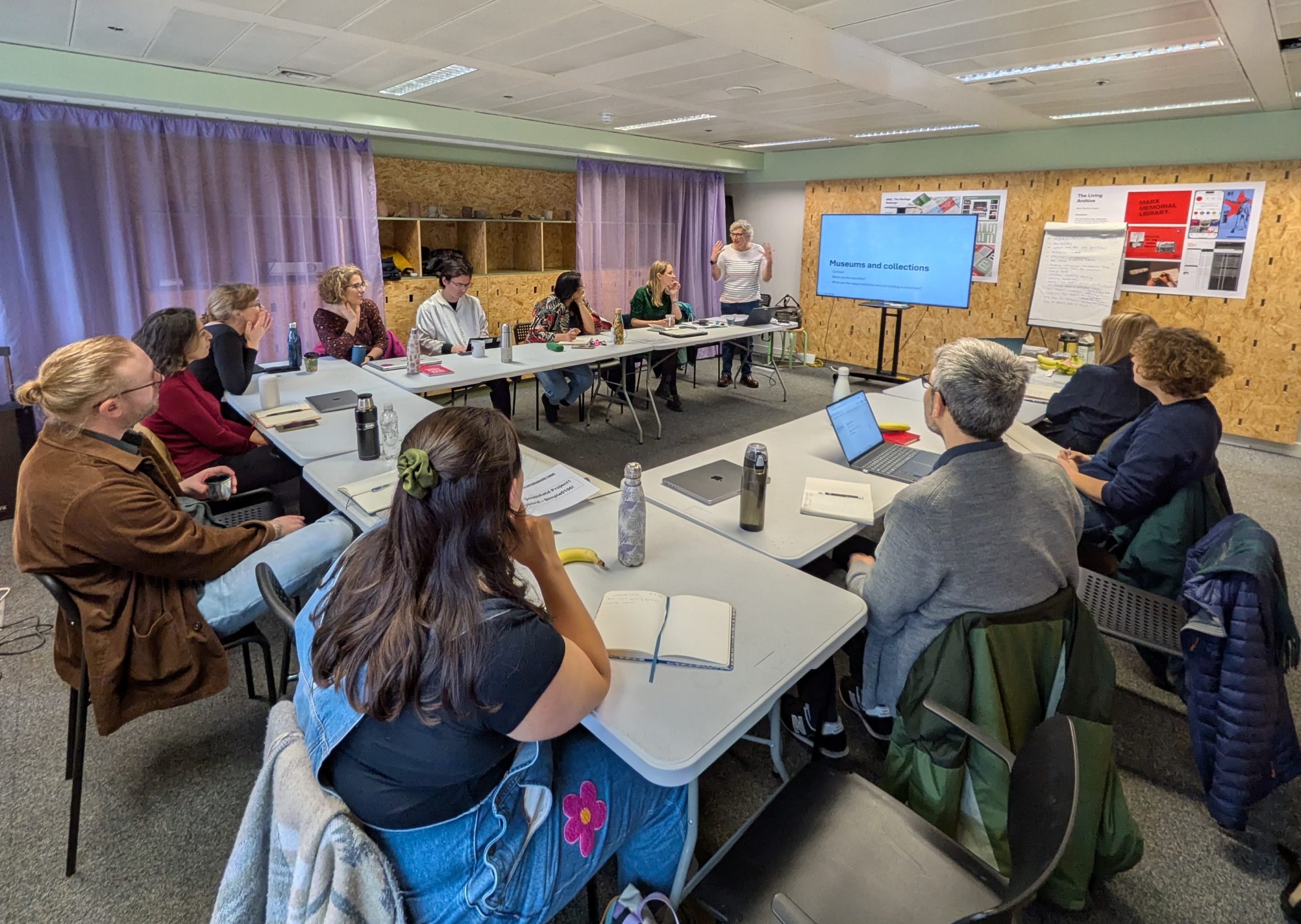
Migration Museum staff at collections workshop led by Claire Fry and Emma Chaplin. Photo credit: Migration Museum.
Some staff expressed their concerns that an object collection would mean traditional object displays – and there would be a deadening of the stories that we sought to convey.
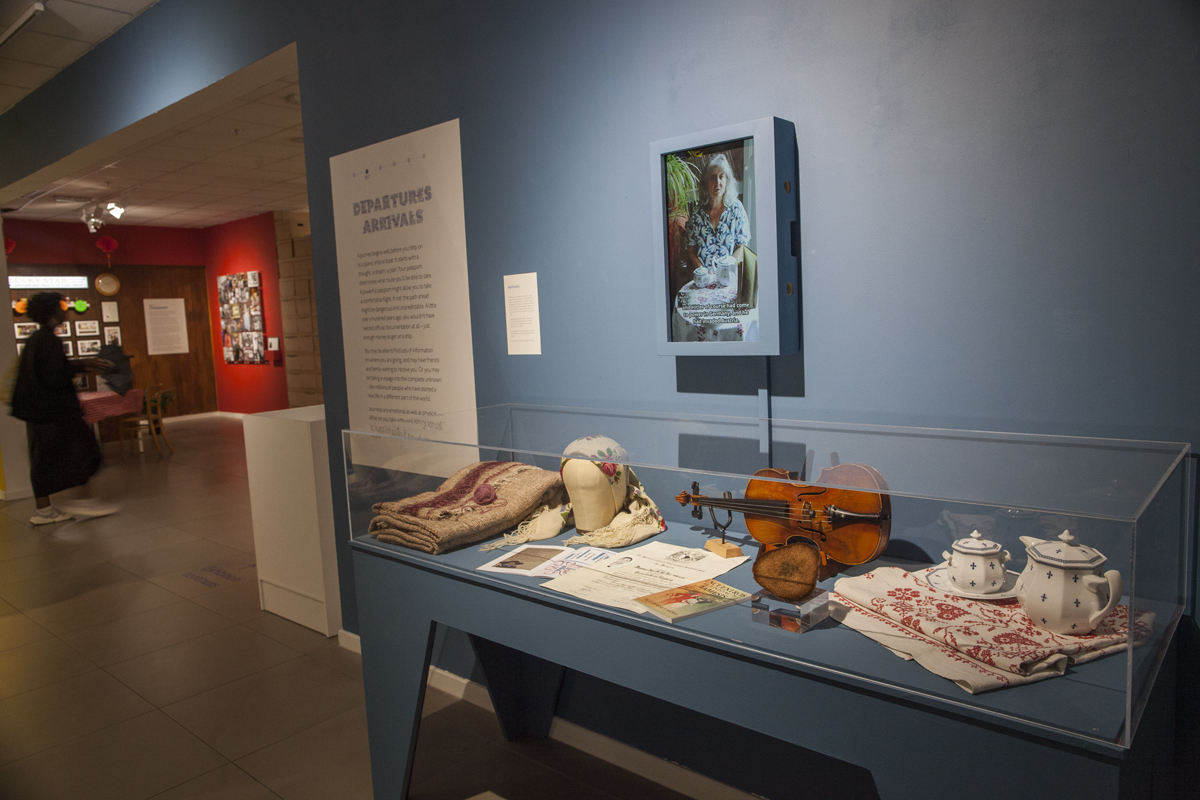
In Keepsakes, a past exhibition that displayed a group of objects together in a case, we included video testimonials from contributors alongside the objects. The contributors’ voices served as the primary lens for interpreting the objects. Similar approaches might not be possible when displaying more historical artefacts.
We also don’t want to have an extractive collecting policy that decontextualises objects and takes them out of the homes where they have the most value.
Keepsakes display as part of All Our Stories exhibition in 2024 at Lewisham Shopping Centre. Photo credit: Elzbieta Piekacz.
Two key messages
We left the workshop with two key messages: 1) A collection needs to work for the museum’s mission and values 2) Accreditation is a scalable process – we can join it with a small collection
To date, the museum has documented and preserved over 10,000 migration stories through its story discs. As a participatory museum shaped by lived experience, we work with groups to grow our living collection of migration stories. We have convened a People’s Panel of over 50 community members to act as collaborators and critical friends, helping gather stories and shape the museum’s future direction.
People’s Panel members are currently recording the lived experiences of migration with people within their networks – friends, family members, neighbours, colleagues, and comrades. Through oral history interviews, they are capturing narratives that the museum will preserve for future generations. We’re looking forward to seeing which objects may appear along the way – some of which may become part of our exhibition content in the future.
We have been working with Emma Chaplin to draft the museum’s first Collections Development Policy. This document is giving us the chance to define our priorities for the permanent collection. We will continue to be story-led, we will focus as much on the present as on the past, and we will only collect where we have the capacity to care for objects in the long term.
Furthermore, our exhibitions will showcase objects held by other museums, community heritage organisations and individuals, and we will look to grow our digital dispersed Migration Collection. In this way, we can continue what the museum does best: welcoming people in and asking them to join us in our work, through their feedback, their engagement, their volunteering and advice. And we can also begin to do what only a museum can do – preserve objects that hold and reflect all of our stories of migration to and from the UK.
We are grateful to the Museum Ethnographers Group (MEG) for inviting us to write this blog post and for granting us permission to republish it in full on our website.
MEG is a UK-based international collective and subject-specialist network. Our members include museum professionals, academics, researchers, students, artists, activists, and others who care for and engage with global cultural collections.Find out more
Our collections research work was made possible thanks to funding from the National Lottery Heritage Fund. Thanks to National Lottery players.
The New Londoners, an exhibition featuring portraits of families from all over the world who call London home, is on display in the Breathing Space café section of the Migration Museum until 27 May. This blog profiles the exhibition, which features the photographs of Magnum photographer Chris Steele-Perkins, a long-term supporter of the Migration Museum. It includes a ‘behind-the-scenes’ section written by Patrick Dowse, one of Chris’s photographic assistants, about the process of securing the photographs.
Within the UK there is nothing new about the perceived difference between London and the rest of the country – historically, there has always been resentment of the capital, for its wealth, its perceived low morals, its mix of people – but a recent survey of these differences showed the contrasts to sharp effect. One of the strange omissions from that survey, however, was the ethnic make-up of London in comparison with the rest of the country – strange, because London is known for its multi-ethnicity and is seen now to be probably the most ethnically diverse city in the world.
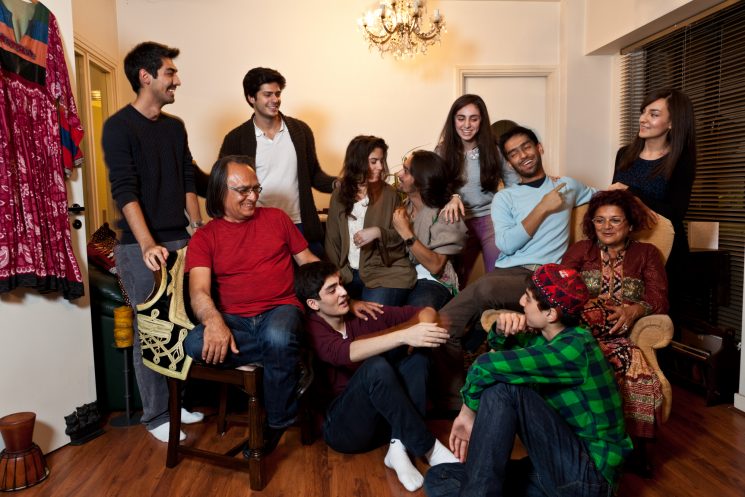
Haroon (left, seated) with his wife, Amina (right, seated), with their sons Milad and Manni (behind Haroon) and nephews Abdullah, Owain and Hamza. His niece Homaira (centre), with her son Imaan and daughter Negeen, and family friend Live (far right).
This multi-ethnicity lies at the heart of Chris Steele-Perkins’ The New Londoners project: ‘The whole world is here in London, and it is the most multi-cultural, most ethnic city in the world,’ he says. And, as a migrant himself and someone of mixed parentage (he was born in Myanmar when it was still called Burma, and identifies as half-Burmese), he was aware of the complexity of identity, both for individuals and for people constantly questioning individuals about it. ‘The question I still continue to be asked is “Where are you from?”,’ Chris says, ‘which has often got the subtext that you don’t really belong here.’ And yet, quiet evidently, people increasingly do feel they belong here, and one of the distinctive characteristics of the capital is the apparent ease with which cultures and ethnicities exist alongside each other. A new kind of identity seemed to be emerging, a new kind of Londoner, and Chris set out to document it, attempting to take photographs in London of people from all the 195 countries recognised by the United Nations (UN).
He set out to do so with a number of common principles: the photographs would all be taken in the subjects’ households; they would be of families, however they interpreted the meaning of family; they would be formal photos; and they would be accompanied by the transcript of an interview between Chris and the subjects of the photos. The result is The New Londoners, which exists as a website, as a photobook (published by Dewi Lewis and on sale in our bookshop) and as an exhibition, in the Migration Museum until 27 May and at the British Library until 7 July. The book, which documents 164 families (collectively hailing from 187 countries) was to be published on the day that the UK was due to leave Europe (Friday 29 March); its launch took place instead on Thursday 4 April at the Migration Museum.
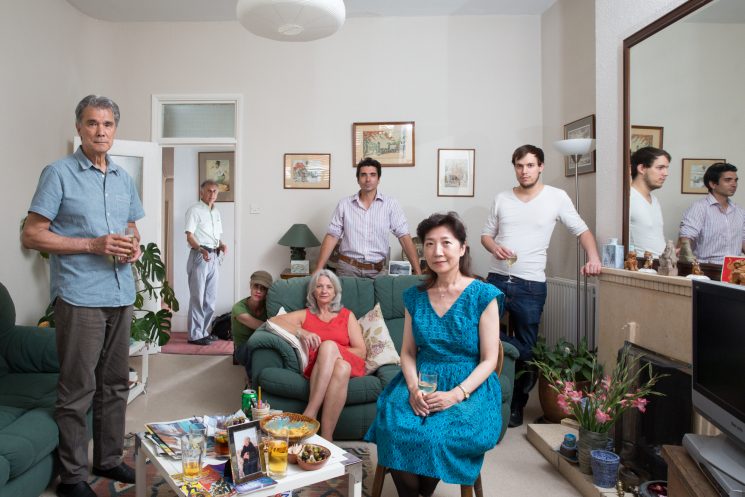
‘My own family is a pretty decent fit for the family profile – with my wife [Miyako Yamada, foreground] being Japanese, my half-brother [Thein Mynt, left] half-Australian and me [in the door-frame] half-Burmese – so fairly early on I thought I would include myself, but built around my brother rather than me: I’m tucked away at the back. My mum’s in the picture as well, a small tiny framed print in the foreground.’ Also in the photo are Chris’s son, Cedric, by the mirror; Thein’s wife, Jean Miller, on the sofa; their son, Lewin, behind the sofa, and his partner, Francis, kneeling beside it.
Chris put feelers out through various contacts, but he was introduced to many of the people he photographed by subjects of earlier photographs, or he stumbled across them by chance, for example meeting a colleague of somebody from the Marshall Islands at a Magnum book-signing event. Some of the stories he heard from families, particularly those who had fled war, were harrowing: the matriarch of the Congolese family was tearful remembering the situation that led to her leaving her home country, the father of the Afghan family explained how the rise of militant Islamist rule meant his job as a satirical comedy writer was not only untenable but put his life in danger, and his wife spoke longingly of an era when women worked and wore skirts – painting a now unrecognisable picture in light of contemporary, conservative Afghanistan.
Having set himself the challenge of photographing people from every country in the world residing within the capital, Chris found that the concept of categorisation of countries presented some interesting questions. For one thing, some of the people he photographed identified themselves with countries – Kurdistan or Somaliland, for example – that have not been recognised by the UN. But there were other issues, too.
‘The idea had originally been to try to put together families from all the UN-recognised states, but I kind of gave that up as an idea because it seemed to be artificial,’ Chris explains. ‘I was intrigued to discover people from places like the Chagos Islands. They didn’t particularly want to be here. They hadn’t come of their own free will, as most migrants to Britain do. It’s a sad irony that they’re here, not because they’re trying to escape tyranny; it’s the opposite, they’re trying to get back to their homeland.’
Patrick Dowse, one of Chris’s assistants on The New Londoners, writes about his experience:
In the summer of 2015, as a bright-eyed and bushy-tailed student photographer, I found out that Chris Steele-Perkins was looking for an assistant for a project. I leapt at the rare opportunity to work with someone with such a rich photographic history.
Coming from a relatively small town in the North-East of England, London was a huge culture shock, which was partly why I had wanted to study in this city; to be part of a team working on this project with Chris only added to the excitement – and working on this project was a brilliant way-in to learning about and meeting people from a huge range of cultures and countries.
By the time I started working with Chris the project had been underway for over a year, but there were still about 160 countries left to cover – a lot of work still to do.
I worked alongside a team of other assistants and researchers, tracking down the remaining families, often contacting embassies, local community groups, blogs and online groups, such as Facebook groups set up for those living in London from different countries.
Social media such as Facebook were invaluable to me – I could use them to connect with those we had still yet to cover in the book: for example, I was able to contact someone from Tajikistan through a Facebook group set up to connect people from Tajikistan living in London and the UK.
We were welcomed into the homes of the families we photographed with open arms. As well as talking about that very British topic of the weather, we often had extensive conversations about their journey to the UK. And one thing I noticed was that, no matter which country we were photographing, no matter which part of the world they were from, we were always offered a cup of tea. That’s one thing that I noticed we all do in the UK when welcoming someone into our home.
Being given the rare chance to work on a project like this has taught us that we’re all the same as each other, no matter which country we’re from. Someone from every corner of the world has found London and now calls it their home. We all want the same thing: happiness, love and community. That’s all we’re after, whether we’re from the UK or Uganda, Venezuela or Vanuatu.
The impact on the project of the 2016 referendum
Chris began the project two years before Britain voted to leave the European Union in 2016. As the project widened, Chris came across people who had moved to London from all over the world for reasons as wide ranging as their countries of origins: work, study, love, curiosity. Some were asylum seekers and refugees, others students or people who had moved for their business. ‘These are the kind of ordinary, decent people who are getting by and doing stuff; [they represent] the exact opposite of the rhetoric that came out of the Leave campaigns,’ says Chris. ‘They are in all kinds of jobs, and in all kinds of work, and have all kinds of histories; not one of them strikes me as someone who’s just kind of sitting back and abusing benefits.’
Since that vote, many foreign nationals in the UK have spoken about a change in feeling, and now wonder what their futures hold, and whether they are still welcome. After the referendum, Chris says, there was a sense that people felt more vulnerable: most of the potential participants in the project who subsequently changed their minds about being involved did so in that ‘post-referendum era’.
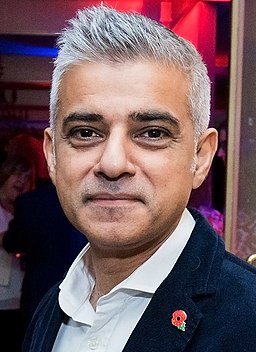
Unlike the majority of England and Wales, London voted to remain part of the European Union in the 2016 referendum. Later in the summer of 2016 the newly elected mayor, Sadiq Khan, a British Muslim of Pakistani origin, launched the #LondonIsOpen campaign, proclaiming: ‘London is the best city in the world. We are entrepreneurial, international and outward looking. London is known as a city full of creativity, a place where anything is possible. The key ingredient of our city’s success has been the flow of brilliant ideas and talent from across the globe. Our city is comfortable in its diversity, proud of its history and optimistic about its future. London is open.’
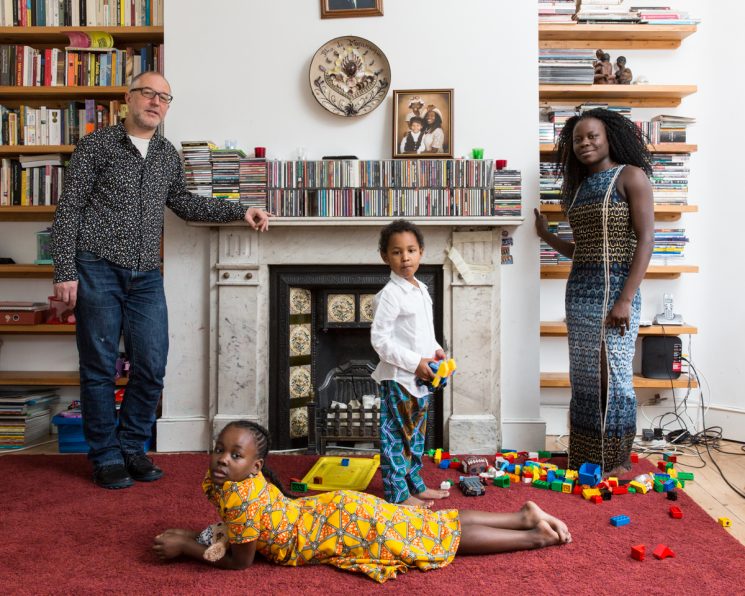
Gert Van de Meersch (left), from Belgium, with his wife, Atija Sulubito Puma (right), from Mozambique, with their daughter, Marcia, and son, Sander. Marcia was born in Mozambique and came to London when she was two.
‘All these things go against the rhetoric of the Brexiteers,’ says Steele-Perkins, who moved to the UK from Burma (now Myanmar) aged two. ‘I think it’s kind of pathetic sometimes, hearing this notion of British values and things like that, as if we’ve had some kind of static system, which is unchanged and suddenly it’s been threatened by people coming in. The whole history of this island has been people coming here due to wars, colonial movements, European movements and so on; what we’ve got now is a product of a process of continuous evolution, which will continue.’
At a time of renewed racism and xenophobia, Chris considers The New Londoners a historical document. That the British Library has taken it into its collection is significant for him, adding to ‘the sense of it belonging to the tradition of recording’ – recording what Chris feels is the ‘greatest political issue of our time: migration’.
The New Londoners exhibition is on in the Breathing Space café at the Migration Museum until Sunday 26 May and at the British Library until Sunday 7 July. From 12 June to 8 September, it will be on display at Somerset House, London, as part of the exhibition Kaleidoscope: Immigration and Modern Britain.
The photobook, The New Londoners, costs £35 and is published by Dewi Lewis and available in the Migration Museum’s bookshop.
Mayor of London, Sadiq Khan, has given his support to the Migration Museum Project and our aim to create a permanent Migration Museum for Britain.
Sadiq Khan said: “For generations, people from every corner of the globe have come to the UK for a better life and, in turn, made our country a more prosperous and vibrant place. The Migration Museum shines a light on how migrants have shaped Britain across the ages by focusing on the human story through educational events and programmes. “London would not be the diverse, successful and open city it is without the many migrants who call it home. A permanent museum celebrating the history of migration would help to ensure people of all ages and backgrounds appreciate both the struggle and triumph experienced by migrant communities moving here.”
The Migration Museum Project has staged an acclaimed series of events, exhibitions and education workshops since 2013, as we work towards our goal of creating a permanent Migration Museum for Britain. Our exhibitions and events have been attended by over 100,000 visitors, while more than 4,000 school children have participated in our education workshops.
We opened the Migration Museum at The Workshop in Lambeth, London in April 2017, building on our previous work and providing a showcase for the permanent Migration Museum for Britain that we are creating. Being based at a central London venue until at least May 2018 is enabling us to stage a varied programme of exhibitions, events and workshops, raise our profile, expand audience reach, deepen links with community groups and schools, and test ideas for our permanent museum.