Archives
3 August, 2016
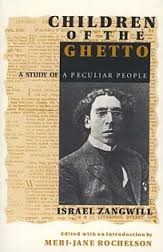
What was the attitude of the Victorians to immigration, particularly Jewish immigration? What was the mood of the country leading up to the passing of the Aliens Act in 1905? And what parallels are there between the experience of immigrants then and now, one hundred years later? The focus of this guest blog is Israel Zangwill and his late-19th-century book Children of the Ghetto; Nadia Valman, who has created an app that allows people to explore the Spitalfields area through the medium of the book, flags up a surprising number of parallels between the two periods.
Children of the ghetto
Israel Zangwill’s 1892 novel Children of the Ghetto is a landmark publication in English literature: the first Victorian novel to offer an insider’s perspective on immigrant lives in London. It offered the reader a wide social panorama, including rabbis, schoolteachers and philanthropists, garment workshop bosses and machinists, socialist organisers and poets, immigrant parents and English-born children. Published to great acclaim at a time of rising popular feeling against immigration, the novel aimed to make a significant political intervention by fostering understanding of a mostly voiceless migrant population.
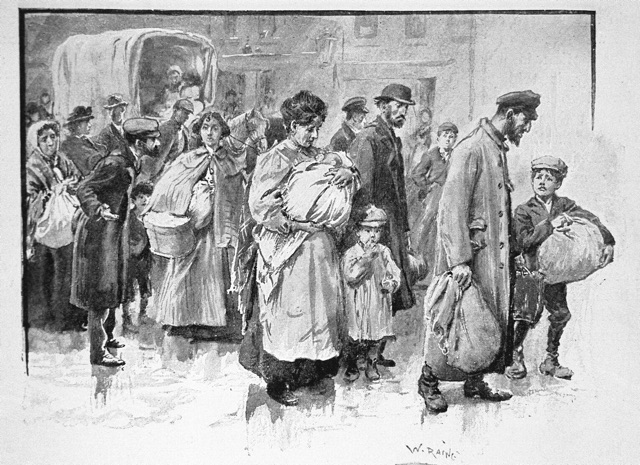
Zangwill was in a unique position as a writer. He had lived most of his childhood in Spitalfields, the area of east London where tens of thousands of Jews, fleeing pogroms, expulsions and economic restrictions in the Russian empire, had settled during the 1880s and 90s. As a teacher at the Jews’ Free School there, he worked among the children of immigrants, most of whom entered school speaking no English. But as a graduate of London University who had moved to Bloomsbury and renounced religious practice, he also observed the Spitalfields Jews at a distance. His novel documented the close ties felt among people who, he wrote, had been forced to live in isolation for centuries, and could not easily shrug off the weight of that history.
Children of the Ghetto blasted onto the literary scene in the year of a general election in which immigration was a hot political topic. Back in the early 1880s, there had been widespread sympathy for the plight of Jews escaping persecution and destitution, and large protest meetings in cities all over the country condemned the Russian pogroms. Soon, however, attention turned to the social impact of immigration. Spitalfields, often referred to as the ‘Jewish colony’, attracted the fascinated gaze of sociologists and journalists. ‘My first impression on going among them,’ wrote Mrs Brewer in the Sunday Magazine in 1892, ‘was that I must be in some far-off country whose people and language I knew not. The names over the shops were foreign, the wares were advertised in an unknown tongue, of which I did not even know the letters, the people in the streets were not of our type, and when I addressed them in English the majority of them shook their heads.’ Others reacted with antagonism rather than bewilderment. The anti-immigration campaigner Arnold White declared that, unlike Christian refugees to England, Jews formed ‘a community proudly separate, racially distinct, and existing preferentially aloof … A danger menacing to national life has begun in our midst,’ he warned, ‘and must be abated if sinister consequences are to be avoided.’
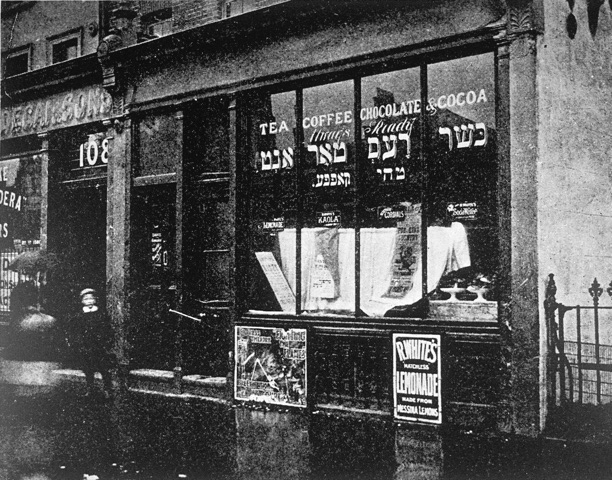
As with other immigrants before and since, the Jewish immigrants of the 19th century introduced new tastes and refinements to London.
By the early 1890s a group of Conservative back-benchers were increasing pressure on the government to control immigration. The failure of their efforts in the following years has been attributed by some to the impact of Children of the Ghetto. But rising unemployment and discontent at the end of the decade provided the opportunity for two East End Conservative MPs to form the British Brothers League, which aimed to galvanise local support. A mass rally in January 1902, held at the People’s Palace, Mile End Road, was advertised as a ‘great public demonstration in favour of restricting the further immigration of destitute foreigners into this country’.
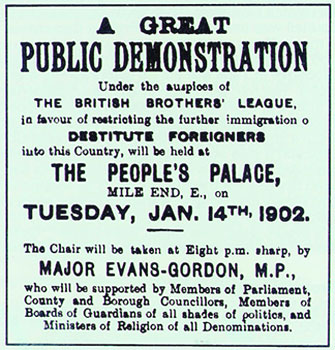
The British Brothers’ League was formed in 1902 to campaign against immigration; it was organised on vaguely paramilitary lines. Dribbling into obscurity in 1923, the League was in many respects the precursor of the British Union of Fascists, which had a significant and unsavoury presence in the 1930s.
It was partly in response to this popular hostility that the first immigration restriction act for a century was passed in Britain – the Aliens Act of 1905. The Act, while retaining the right to asylum on political or religious grounds, gave government inspectors power to ‘prevent the landing of undesirable immigrants’, including ‘invalids’ and ‘paupers’ – those who could not show that they were capable of supporting themselves – and thus excluded not only the sick and elderly but also those who arrived destitute, often having been conned or robbed of their assets on the journey.
There are many resonances between popular anti-immigrant feeling then and now. In the early 20th century, it helped to channel and defuse Eastenders’ anger at their chronic poverty and insecurity. Jews were accused of lowering the standard of living with ‘sweatshops’ – small workshops characterised by poor working conditions, long hours, low pay and seasonal fluctuation, and of causing the housing shortage that had led to extreme over-crowding. Yet in fact both problems were rife in the East End long before the Jews’ arrival. Hostility to immigrants came from pervasive lack of understanding about the real economic causes of local unemployment, such as trade depressions, mechanisation, and competition from manufacturers in the provinces.
In this context, there was considerable pressure on Israel Zangwill to produce an uplifting account of Jewish Spitalfields, countering misconceptions and demonstrating how Jewish immigrants were contributing positively to the economy and living pious, law-abiding lives. That pressure is evident in aspects of the immigrant subculture that he deliberately left out of the novel: the gang violence, the prostitution, and gambling clubs.
Nonetheless, Zangwill took a bold stand against a number of contemporary stereotypes. Petticoat Lane market, for example, at the heart of the immigrant area, was invariably associated in the Victorian press with danger and dodgy dealing, but it has a very different meaning from Zangwill’s perspective. He describes Petticoat Lane as a place where Jews of all social classes congregate to experience the smells and tastes that remind them of their roots.
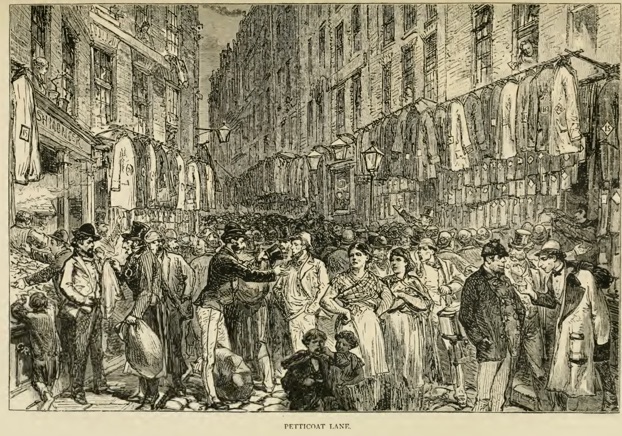
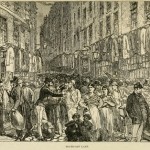
Petticoat Lane, 1878.
‘The Lane was always the great market-place,’ he writes, ‘and every insalubrious street and alley abutting on it was covered with the overflowings of its commerce and its mud … The famous Sunday Fair was an event of metropolitan importance, and thither came buyers of every sect … A babel of sound, audible for several streets around, denoted Market Day in Petticoat Lane, and the pavements were blocked by serried crowds going both ways at once.’ In his account of the market, Zangwill emphasises its vitality and vulgarity. The distinctive dynamism of immigrant culture, for him, was precisely what was valuable about it. But the market was far from being a ‘ghetto’: it was here that Jewish culture was shared with ‘buyers of every sect’. Unusually for a Victorian novelist, he regarded London’s multiculturalism as an asset to be prized.
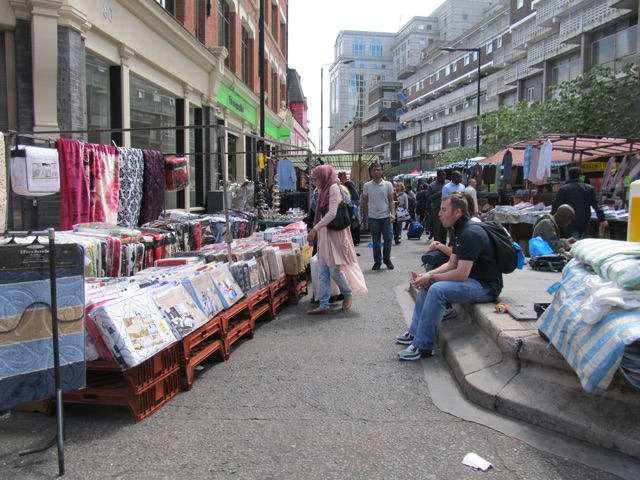
Petticoat Lane, 2015.
Zangwill also broke new ground in depicting the diversity of contemporary Jewish life. Although it would have been easier to advocate for Jewish immigrants by representing them as a cohesive community with shared needs and aspirations, he instead drew the novel’s dramatic scenes from the conflicts of class, religion and generation that fissured it. He intended, he wrote, ‘to exhibit clearly that the Jew, like the Englishman, cannot be summed up in any single, or indeed in any score, of types’. Children of the Ghetto explores divisions among Jews who are wealthy and poor, orthodox and secular, immigrant and English-born, men and women, parents and children. This was a fractured, deracinated population – uncertain of its future, at a moment of critical change.
It’s this complexity that I want to convey in Zangwill’s Spitalfields, a smartphone app that uses Children of the Ghetto as the basis for a walking tour of the Spitalfields area. The app brings to life the dilemmas that beset immigrants and their children in the context of fierce debates about migration from more than a century ago. Like the novel, the app’s narrative follows the story of Esther, a London-born ‘grandchild of the ghetto’, her routes between soup kitchen and school, attic home and marketplace and her changing relationship to Spitalfields. Many of the sites where Zangwill stages the novel’s key scenes are still extant, offering a series of physical settings where the app augments extracts from the novel with related visual and aural materials from the period. And I’m able to use the unique capacity of mobile digital technology to immerse the listener in Spitalfields’ past while remaining attentive, or becoming more attentive, to its present, as you walk through a streetscape shaped by more recent histories of migration.
Perhaps the most remarkable fact about Children of the Ghetto is that it became a bestseller following its publication and was repeatedly reprinted for several decades. Written in the context of widespread confusion about immigration, the novel opened up a little-known world to the reading public. But Victorian readers found more than novelty in its pages: they also encountered the story of a daughter rebelling against her father’s authority, a father striving to understand his son’s lack of interest in his family’s traditions, a woman longing for the warmth and security of her childhood home. Readers discovered that the struggles of Jewish immigrants in Victorian London were not so different from their own.
Nadia Valman is Reader in English Literature at Queen Mary, University of London. She researches and teaches the literature of east London, where she also leads guided walks. She wrote and curated the free downloadable smartphone app Zangwill’s Spitalfields.
11 July, 2016
One of our core ambitions has always been to tell the long story of migration into and out of this country – partly because every immigrant into one country is an emigrant from another, and partly because people forget that, until the 1970s, the United Kingdom was a net exporter of people: more people left the country than entered it. The story of emigration from this country is fascinating and often horrific – and the parallels between ‘then’ and now are all too obvious. In this guest blog, Matthew Crampton, writer and folk singer (whose latest book is Human Cargo: Stories and Songs of Emigration, Slavery and Transportation), tells some of these stories and shows how folk song can allow the voice of people caught up in this practice to be heard.
Behind every statistic, a human story
Every statistic I read on migration suggests it brings economic benefits to a host country. Yet most newspaper headlines damn migrants. How do we bridge this disconnect? It’s not enough to state facts. People love their myths. Moreover, those on both sides of the argument tend to view migrants solely as statistics. Maybe story, and song, can help us re-frame the discussion.
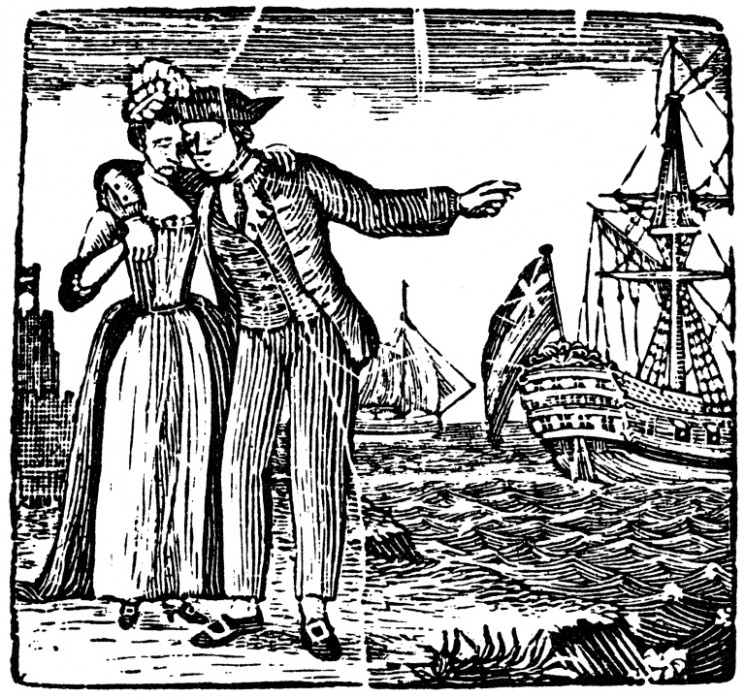
A quayside departure – the young man has just been ‘pressed’ into joining a ship headed for the colonies.
If you look at the lives of those trafficked* or transported in past centuries – particularly in the 1700s and 1800s – you see clear parallels with today. Patterns of cruelty do not change. In 1800, for example, frightened families filled the dockside of the Scottish town of Fort William. They were escaping famine, disease and landlords. Like Syrian families today, they were prey to the slick promises of unscrupulous traffickers, such as agent George Dunoon. He promised comfortable passage to America. Yet he crammed the desperate emigrants into rotten hulks. The crossing was horrific. The death rates for emigrants – though paying passengers – were sometimes higher than on slave boats. How could this be?
The answer, depressingly, is an economic one. Slavers were paid for the cargo they delivered alive; however cruelly the slaves who constituted this cargo might be treated, they were of value to slavers only if they survived the crossing. Emigrant captains, by contrast, were paid in advance, so they had less incentive to keep their cargo breathing. Indeed, the more that died, the more space, and food, for those left behind. Of course there was no moral equivalence: most emigrants, however desperate their circumstances, travelled voluntarily; slaves were transported against their will. And emigrants who survived, and arrived, were often free citizens, not slaves – whereas there was no such freedom for any slave who survived the journey.
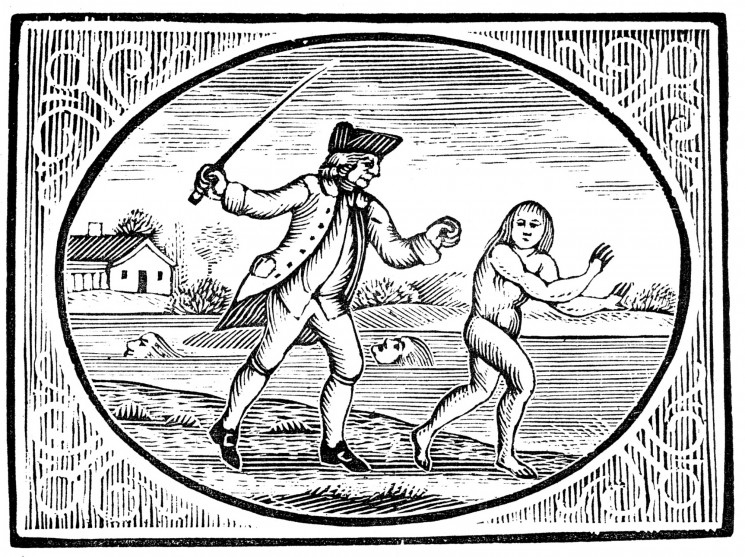
Sex slavery was a common feature of the 18th and 19th century slave trade, occasionally, as here, featuring white women.
The 18th and 19th centuries saw millions of people on the move, a greater proportion of the then populations than today (though Syria is re-balancing the equation). And many of those people were Europeans. It’s estimated that nearly one third of the German-speaking adult population of Europe – some 15 million in total – migrated during the 1700s.
Tiny Britain had seized huge colonies, and needed labour to exploit this new land. Slaves were to provide much of this labour, particularly after the slave trade became highly sophisticated in the latter half of the 18th century. Before that, Britain also exported political prisoners to work the colonies, with Oliver Cromwell sending thousands of Scottish and Irish prisoners to the Carolinas (on the east coast of America). Later, the British government sent felons: you could be transported for 14 years for as small an offence as stealing a loaf of bread. This provided significant labour, at first to America, and then, after US independence, to Australia.
In any case, the majority of Europeans arriving in colonial America were indentured servants. Such servants entered a contract to work for another person for a defined period of time, usually without pay but in exchange for free passage to the new country; they could be bought or sold and, on average, they did not survive their period of indenture. But many did survive, like the remarkable Peter Williamson. He was kidnapped aged ten in Scotland, then ‘spirited away’ to be sold as a servant in South Carolina.
While playing on Aberdeen quay, he later wrote, ‘I was taken notice of by two fellows belonging to a vessel in the harbour, employed by some worthy men of the town, in that villainous and execrable practice called kidnapping.’ Such traffickers, known as ‘spirits’ (hence ‘spirited away’), sold him in Philadelphia – for sixteen pounds – for seven years’ indenture on a plantation. Much of that money would have made its way back to the Aberdeen magistrate who helped organise the seizure.
There are many such stories of human cargo from the time.
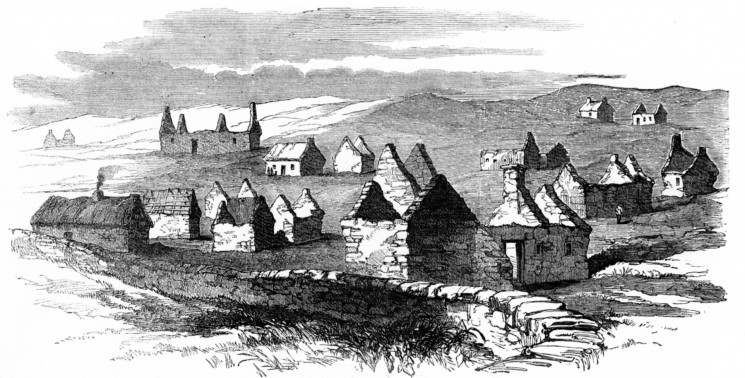
The Highland Clearances, undertaken in the 18th and 19th centuries by unscrupulous landowners seeking to change the use of the land from agriculture to sheep farming, was the source of a huge movement of people from the heart of Scotland to the large towns and, further afield, to the British colonies. In its wake, abandoned crofts were the only record of a once-thriving Gaelic community.
Catherine McPhee was ‘cleared’† by her Hebridean landlord, who gave her just hours to pack up her life before forcing her onto a boat, next stop Nova Scotia. James M’Lean was an American sailor, pressed into the Royal Navy and forced into many years of horrific service across the world. Robert Whyte wrote a chilling account of life (and death) aboard an Irish ‘coffin ship’ bearing emigrants to America, which was later published as Robert Whyte’s 1847 Famine Ship Diary: The Journey of an Irish Coffin Ship.
And Olaudah Equiano provided us (in his 1789 autobiography, The Interesting Narrative of the Life of Olaudah Equiano) with a rare first-hand slave’s account of the Middle Passage from Africa to America. He wrote ‘It was said the stench of a slave ship was so strong that other sailors could smell it a mile downwind, and that the odour of vomit, sweat and faeces of its human cargo worked its way into the very wood and could not be scrubbed away.’
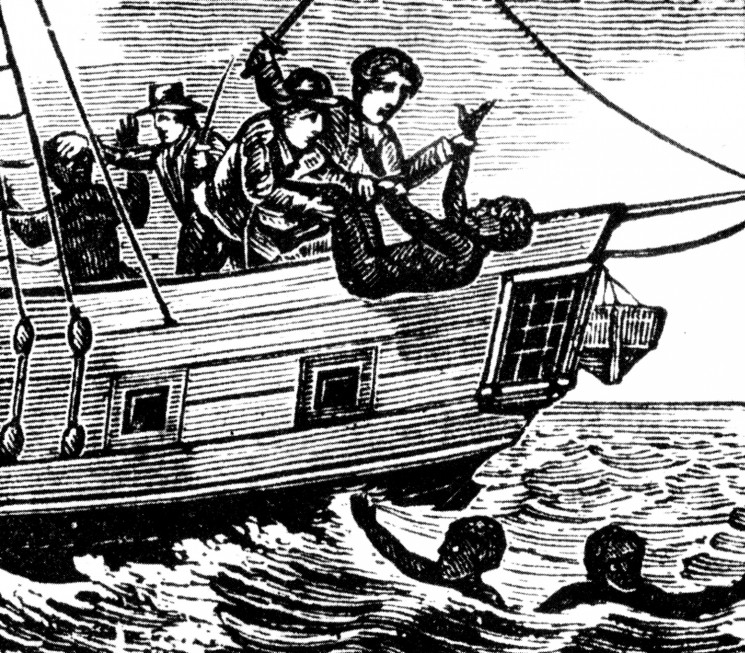
Olaudah Equiano was instrumental in drawing to public attention the horrific 1781 massacre of African slaves on the slave ship ‘Zong’. The ship’s crew threw 133 Africans over board when the ship ran low on drinkable water – but also to cash in on insurance repayments for the ‘loss’ of the ship’s cargo. The case against the ship owners was unsuccessful but is said to have led to the abolitionist movement in Britain.
These stories help humanise the history of migration. But history tends to record the rich, the resourceful and the lucky. What of the masses, the poor or illiterate, who left no testimony?
Here, interestingly, we can turn to folk song. Vast numbers of folk songs exist from this period. They’re mostly anonymous, passed down orally until transcribed by a song collector. Or they were printed crudely on broadsheets, sold cheaply in the streets of Hanoverian or Victorian England.
Though anonymous, folk songs can provide an authentic record of ordinary people. There’s a song called “Paddy’s Lamentation”, or “By the Hush”, whose chorus sings:
Oh you boys, now take my advice
To America I’d have you not be coming
For there’s nothing here but war,
And the thundering cannons roar,
And I wish I was back home in dear old Ireland.
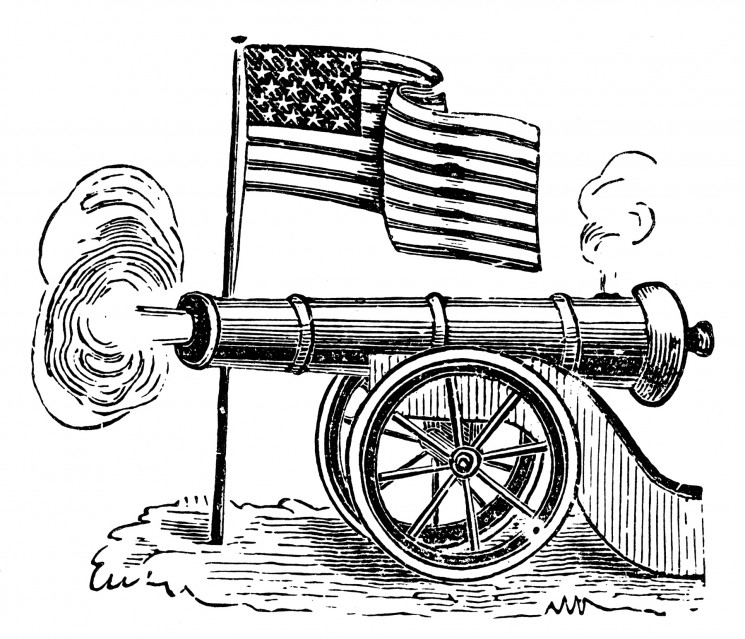
Union flag and cannon – on their arrival in America, many indentured servants found themselves drafted in to fight on behalf of the Unionist cause.
“Paddy’s Lamentation” highlights a little-known story about migration from the time. During the American Civil War, the Union Army sent recruiting agents to post-famine Ireland. They promised free Atlantic passage to young men, in return for a bit of work. On arrival in New York, all excited, the men would not be allowed to disembark until they’d signed up to join the army of the northern states. Within months, or weeks, they might be on the battlefield of Gettysburg, where, like the narrator of this song, they lost a leg, or worse.
Migrants who’d survived the crossing could not depend on Trip Advisor to chronicle their duplicitous traffickers. But word could reach back home with songs like this.
For my book Human Cargo, I found many such stories, and songs, which chart the breadth of migration in past centuries. These touch areas such as emigration, slavery, the press gang, sex trafficking and convict transportation. Where possible, I’ve included modern testimony, for example contrasting a trafficked Japanese sex worker from 1905 with the recent experience of a young Albanian woman lured into Italy. Or I link the vicious practices of the press gang with the recruitment of African child soldiers today.
As I say in the introduction, today’s refugee crisis demands witness – and action – but is hard to grasp. Story and song won’t solve the problems, but they can help find a way in.
*The terms ‘trafficking’ and ‘transportation’ in the 18th and 19th centuries include those carried involuntarily – such as slaves, prisoners and the forcibly displaced – and those travelling by choice (even if it was a desperate choice), such as most emigrants.
†Another way of saying ‘forcibly displaced’ – this process, which took place over a period of 100 years in the 18th and 19th centuries, is now referrred to as the Highland Clearances.
Matthew Crampton’s book, Human Cargo: Stories and Songs of Emigration, Slavery and Transportation, is available for £10 – more info here. The pictures accompanying this article come from the 50 illustrations in the book.
1 July, 2016
One of the more unpleasant effects of the referendum result has been a spike in anti-immigrant activity, with abuse hurled at Poles in the street and graffiti daubed on cultural centres run for and by EU migrants. This change in atmosphere, allied to the uncertainty of their future status in a UK divorced from the EU, has led to understandable anxiety among immigrants from other EU countries. In this guest blog, taken from his Free Movement blog, Colin Yeo sets out the legal consequences of last week’s momentous decision. Colin recently took part in our panel discussion on ‘The Ethics of People Smuggling’, one of the activities run as part of our recent Call Me By My Name exhibition in Shoreditch, London.
What next?
The people of what is currently the United Kingdom have voted to leave the European Union. What happens now? Here I am going to take a quick look at the immediate consequences for EU nationals living in the UK.
In short, there are no immediate legal consequences that flow directly from the referendum result. The law of the United Kingdom only changes when Parliament enacts a new law through the full Parliamentary process and no such law has been passed. David Cameron, who is stepping down as Prime Minister, has stated that he will not immediately trigger Article 50 of the Treaty on European Union, so there will be no immediate change to free movement laws either.
The longer answer is that we just do not know what will happen in the weeks and months ahead.
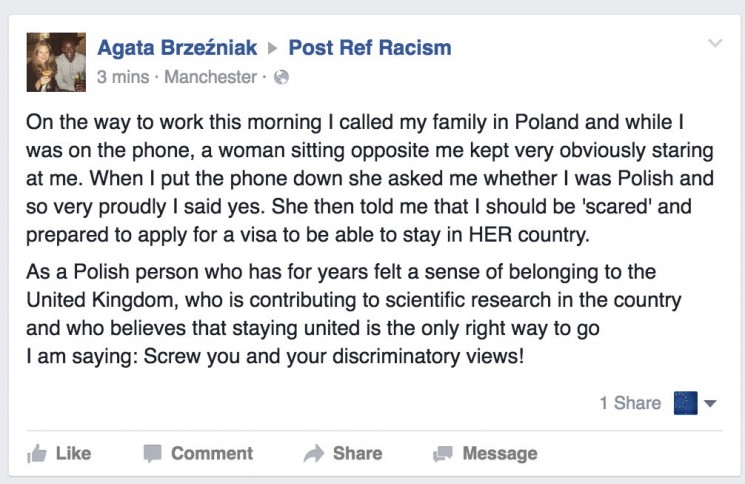
Even before the referendum on 23 June some advertisements – such as this deliberately provocative ad put out by Operation Black Vote – were being criticised for focusing on immigration in a way that was bound to incite animosity.
The Immigration Law Practioners Association put together a series of briefings on different Brexit issues which may be of interest. These are largely speculative, though: no one knows what is going to happen now.
If the new Prime Minister does trigger Article 50, then the UK will leave the EU within a two-year period and will at the point of leaving cease to be subject to EU law, including free movement law.
There is some optimistic talk of Article 50 not being triggered and instead a further renegotiation taking place, and perhaps another referendum. That seems politically very unlikely, and it is hard to see how internal Conservative Party politics would allow for such an eventuality. With the pound plummeting, UK government debts to be downgraded, Scotland to demand a further referendum and perhaps with an exodus of big employers to be announced, I guess the politics may change as people realise what they have done to themselves and their country. But I seriously doubt it. It is done.
It seems certain that some generous provision will be made for EU nationals currently resident in the UK.
There was some talk during the campaign of EU nationals automatically retaining “acquired rights” under the Vienna Convention of 1969. That sounds like legal nonsense to me and Professor Steve Peers seems to think so too. Some specific legal provision will need to be made under UK law in my view. If the Government has any decency and any sense, an announcement on this will be made very quickly.
In the week following the referendum, there had been a five-fold increase in the number of hate crime incidents reported to the National Police Chiefs Council (as of Thursday 30 June).
It seems certain that some generous provision will be made for EU nationals currently resident in the UK. There are around 3 million EU nationals living here, all of whom would need a new immigration status. Many of them do not have residence documents because under EU law residence documents are optional for EU nationals and their family members.
My best guess is that free movement laws would be incorporated into UK law. At the very least this would apply to those who are already resident in the UK as at a certain date. The law would take effect automatically without anyone having to make an application as such. On a sliding scale of ever worse possibilities, the existing rules might be tweaked to make it harder to qualify for settlement and easier to deport, family members of EU nationals might not be treated as generously as EU nationals themselves or, worst case, all 3 million EU nationals would suddenly be required to make new applications under UK immigration laws. This last possibility seems extremely unlikely.
The UK may end up staying in the European Economic Area, like Norway, in which case free movement laws would continue to apply as they do today, including for future residents from the EU. However, given that immigration seemed to be the decisive issue in the referendum — much to our collective shame — joining the EEA seems like the worse of all options, as it would mean continued free movement rules but also continued payments into the EU and no control over the rules to which the UK was signed up.

There is widespread concern that the referendum result appears to have legitimised racist activity.
In the meantime, many EU national residents will be extremely concerned about their position. Family members of EU nationals may be even more concerned. Many will want to apply for residence documents, for permanent residence and for naturalisation as British. I’ve previously written blog posts which may be helpful (all of those below are up to date) and also put together an ebook guide on making EU free movement applications.
On a personal level, let me end this piece by saying how sorry I am to any EU national readers. I am sorry that our country has put you in this position. The vote is an awful, terrible result not just for the UK but for Europe and I am so desperately sad at the outcome and what it says about us.
Other blogs on residence applications by Colin Yeo
How to make a permanent residence application
Home Office confirms that official EEA series application forms are not necessary
Waiting times for EEA residence applications
Expediting an EU residence document application
EU nationals must apply for permanent residence card for British nationality applications
Colin Yeo is a barrister specialising in immigration at Garden Court Chambers who recently took part in our panel discussion on ‘The Ethics of People Smuggling’. This blog was first posted on his Free Movement blog, the widely respected blog on immigration law.
6 July, 2017

I left Afghanistan because the situation wasn’t good. The main reason was the war and the Taliban. People had to leave because of the problem, the politics thing. It’s not very easy to leave. The first thing is you don’t want to leave your country but if the situation comes to you, you have to leave – you leave everything behind – your family, your country, you just go – to a kind of survival, to get away from the troubles, that’s what it was all about – you can’t imagine how hard it is.
There’s excitement in the market – you see lots of people coming and going. Of course it’s hard work but the excitement is there and sometimes it takes the tiredness away from you.