9 December, 2021
Click here to download and view
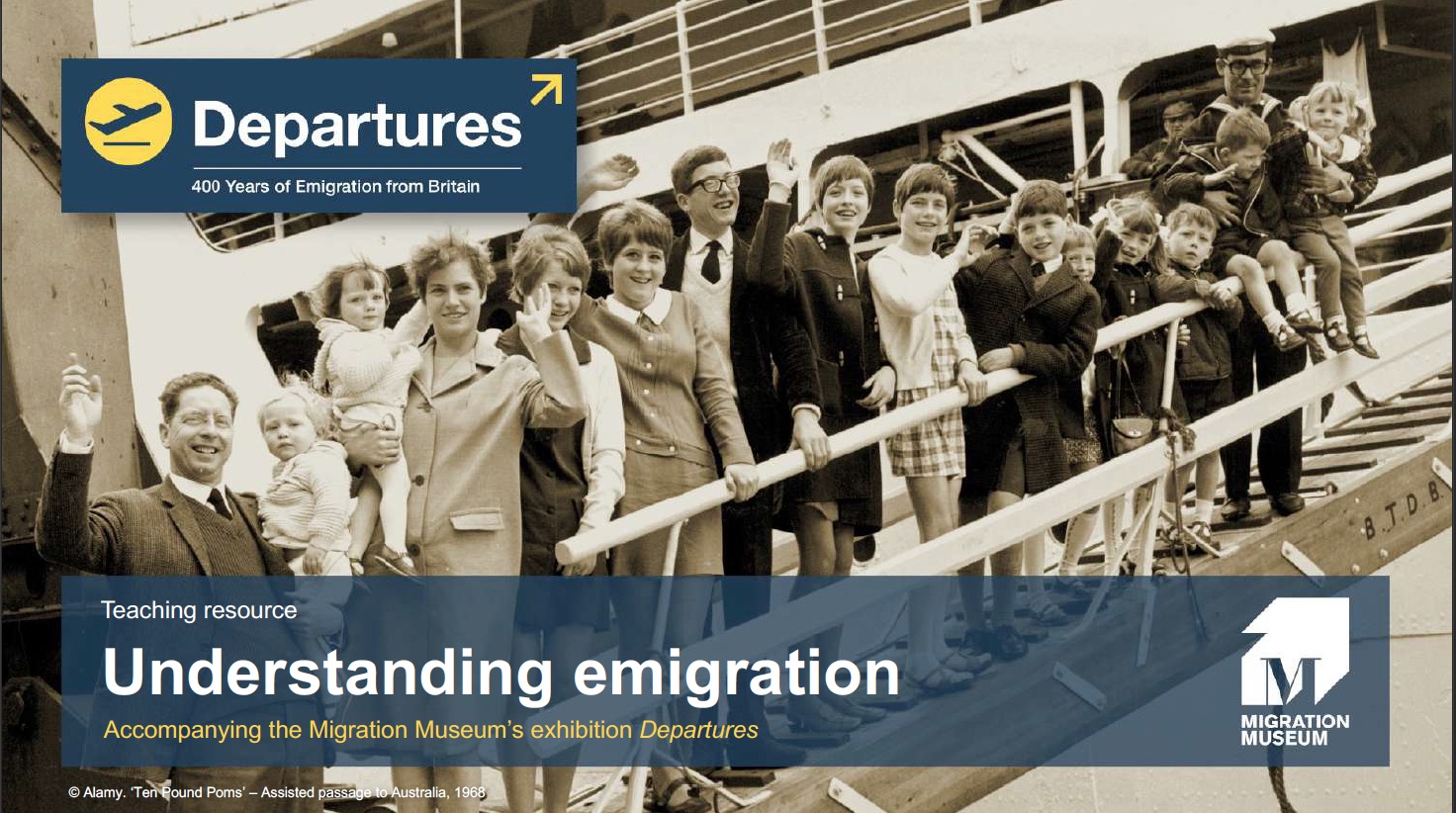
This free, in-depth resource pack shines a spotlight on 400 years of British emigration – one of the largest movements of people in modern history, yet a history that is often overlooked.
Who are the many millions who have departed these shores and why did they go? Can exploring their motivations help us better understand the motivations of people who arrive? What impact has this mass movement had on the world – and on Britain? Our resource pack features stories spanning four centuries – from Mayflower Pilgrims to Welsh emigrants to South America, Child migration schemes to the Windrush scandal.
This resource pack will be helpful to any student studying the impact of emigration from Britain; both on the countries people emigrated to, and on Britain itself. However, the resource pack is designed specifically for Key Stage 4 students studying GCSE History: AQA’s ‘Migration, Empires and the Peoples’ unit. The pack was designed by David Cox and the Migration Museum, with input from AQA teachers and the board’s History subject advisor.
The Departures: Understanding Emigration resource pack accompanies the Migration Museum’s Departures exhibition, but is designed to be used as a stand-alone resource, or in conjunction with a self-guided or facilitated learning visit to the exhibition. To find out more about organising a visit to Departures for your students, please contact our education manager Liberty Melly: liberty@migrationmuseum.org.
18 January, 2022
This collection of artefacts, historical events and personal stories offers an initial insight, for secondary school students, into the impact of historical genocides.
18 January, 2022
This lesson plan uses the story of Martha Blend and other Kindertransportees to discuss the Kindertransport program and the lives it affected.
What happened to the Kindertransport children? – This lesson is suitable for 11–14-year-old students. Through testimony, artefacts and memorials it introduces the history of the Kindertransport – a programme that rescued 10,000 children from the Nazis. It is suitable for use in a range of subjects – such as History, Art and Design, English, RE, PSHE, Citizenship.
Produced in partnership with The Harwich Kindertransport Memorial and Learning Trust, and with thanks to the BBC and The Wiener Holocaust Library.
In this lesson, your students will:
-Learn about Kindertransportee Martha Blend and her autograph book
-Hear what happened to arriving children who didn’t have foster families to go to through historic photos and a rare BBC audio recording of the children and young people themselves
-Explore a new memorial currently in construction and hear from the sculptor himself
View and download the resource here
18 January, 2022
This lesson produced by the Holocaust Memorial Day Trust looks at six occasions where British people took action to resist the persecution of Jewish people during the Holocaust.
This lesson explores the stories of British people who took risks and showed great courage and determination in order to save the lives of Jewish people during the Holocaust. Each have now been awarded a medal as a ‘British Hero of the Holocaust’ by the UK government.
This activity would work well for secondary school students (Key stage 3 and 4 or equivalent) with some basic background knowledge of the Nazi persecution of Jews in the 1930s and the Holocaust. It will help them to make the connection between the Holocaust and Britain during the Second World War, and explore the role of rescuers and resisters.
View and download the resource here